

Keep Help Scout if you run support as a function and want a documentation site beside the queue. Its free plan covers 5 users, 1 inbox and 100 contacts a month, and Standard is $25 per user per month on Help Scout pricing. Look at an alternative when the people answering email are the people fixing the bug, when several addresses need one list, or when a thread has to stay tied to the Linear issue that closes it.
Every competitor price below links to the vendor’s own pricing page.
When staying makes sense
Help Scout is a help desk, and that is a good shape for a team that treats support as its own job. The free plan covers 5 users, 1 inbox and 100 contacts a month, which is enough to answer real mail before anyone pays. Standard removes the contact cap at $25 per user per month, and extra inboxes cost $10 a month each on a paid plan.
Two things come with the product that a shared inbox usually does not. A Docs site ships in the plan, so help articles and replies live in one place. The queue is also built around tickets with statuses, assignments and reporting.
Stay if you have a support function with shifts, a response target to hit, and a docs site to keep current. The move off Help Scout has to buy you something specific, because the free plan and the docs site are not easy to replace for the same money.
When the free plan stops fitting
The limits arrive quickly for a small software team. One inbox on the free plan means support@ and billing@ cannot both live there, and a second inbox costs $10 a month on a paid plan.
The deeper mismatch is who answers. If a developer fixes the bug and then replies to the customer, a ticket queue asks for fields that nobody fills in, and the reporting ends up measuring nothing.
The loop between the reply and the fix is manual either way. The queue and the issue tracker are separate systems, so someone has to carry the status across by hand when the fix ships.
Shared inbox or help desk
Most alternative pages treat these two categories as one. A help desk turns each request into a ticket and manages the ticket lifecycle. A shared inbox keeps the conversation as the unit of work and puts a team around one address.
For a team of five with no support department, the shared inbox is the smaller change. For a team with a support lead and a monthly report to file, the help desk is the tool.
Shared inbox vs help desk works through which one a small team needs, what a help desk gives you that a shared inbox does not, and the signals that mean it is time to move up.
The alternatives, and who each one suits
| Tool | Price | Free plan | Who it suits |
|---|---|---|---|
| Help Scout | $25 per user per month, Standard | 5 users, 1 inbox, 100 contacts a month | A support function that also wants a docs site |
| Missive | $14 per user per month, Starter, billed yearly | No, 30-day trial | Teams whose work is email and who want it keyboard-first |
| Front | $25 per seat per month, Starter, billed annually | No, trial only | A support function that needs routing and reporting |
| Zendesk | £15 per agent per month paid yearly, Support Team | No, trial only | A support department with a large queue |
| Chirp | $9 per user per month, one plan | No free plan | Small software teams on Linear that answer support themselves |
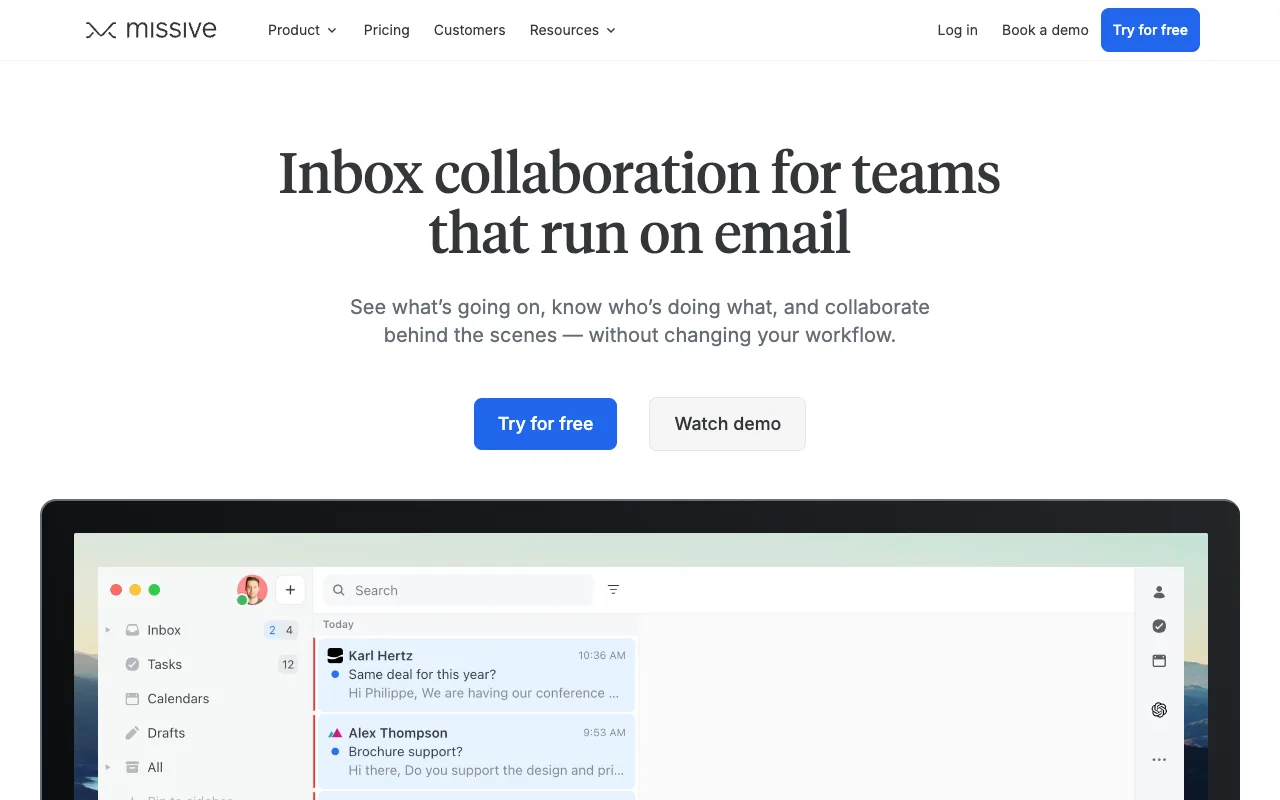
Missive is the closest to Chirp on feel. It is keyboard-first, it costs $14 per user per month on Starter when billed yearly, and its Productive tier adds a REST API and an MCP server. Its customers are general team email, so the issue loop is not part of the product.
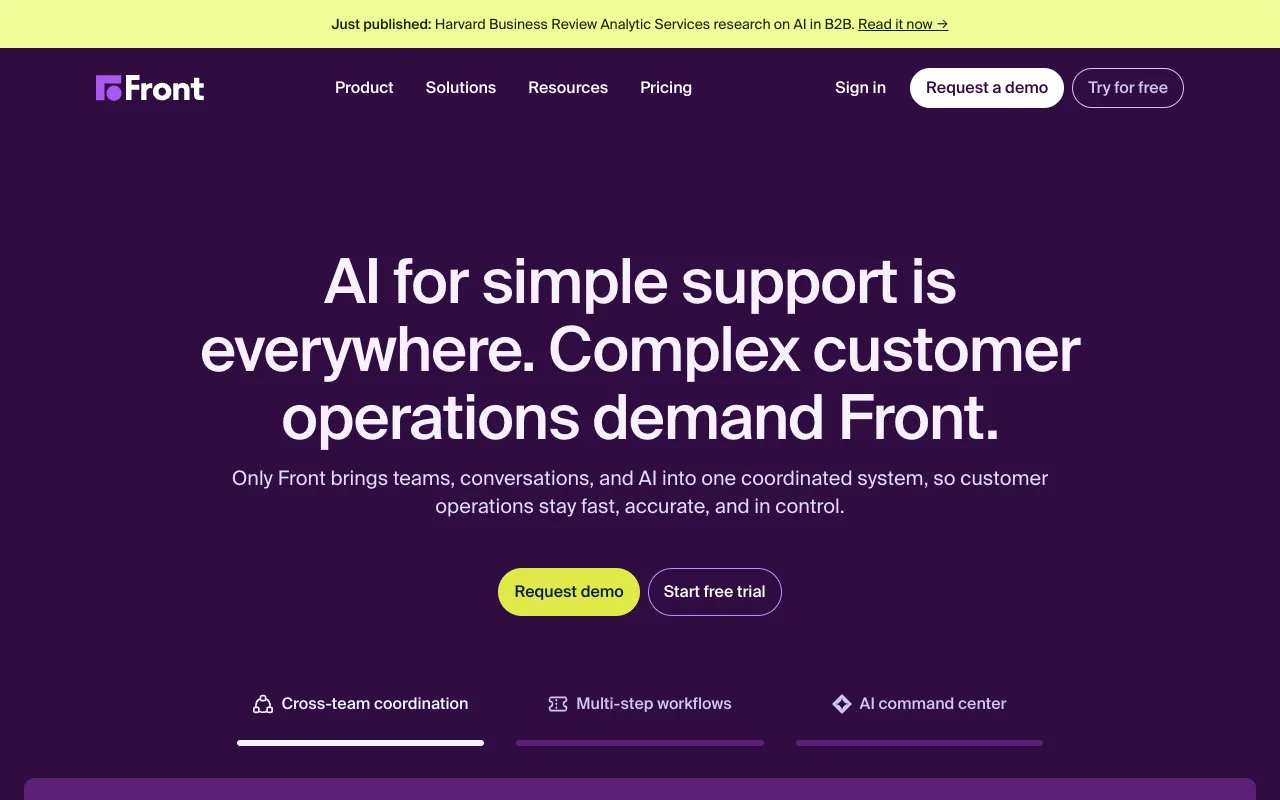
Front is the full version of the same idea for a support function. Starter is $25 per seat per month billed annually and covers up to 10 seats with a shared inbox, ticketing and up to 10 automation rules. Omnichannel routing and macros arrive on Professional at $65, and Front’s rules can send email.
Zendesk is built for a support department rather than a small team. Its pricing page geo-redirects to the UK domain, where Support Team is £15 per agent per month paid yearly and Suite Team is £45. Suite Professional is £89, and Enterprise is a sales conversation.

What users complain about
Piwigo, the open source photo platform, published why they moved their support off Help Scout. The complaint is specific, and it is about price rather than features:
over the years, we saw HelpScout raise its prices, degrade its user experience, and pile on “sexy” but unnecessary features without addressing users’ real needs.
They were paying $60 a month for three agents. On Help Scout’s ticket-based pricing they calculated they would land “in the $150 to $250/month range”, which they call a ridiculous price for a shared inbox.
Read it as one company’s arithmetic rather than a verdict. Their complaint is that the cost scales with volume in a way that stopped matching what they got. If your ticket count is climbing, run that arithmetic on your own numbers before you commit, and note that the free plan and the $25 Standard price are real for a team that stays small.
Chirp for teams on Linear
Chirp is a shared inbox at $9 per user per month on one plan with every feature, built for teams that already track work in Linear. Press i on a thread to link, create or search an issue. Snooze until done, and when every linked issue is Done or Canceled the thread reopens with a drafted reply that names the issue. The Issues view (g i) sorts linked issues by how many customers are waiting.
The automation is deliberately narrow. Rules can close, tag, assign and snooze threads and write drafts, but a rule has no send action, so it cannot email a customer on its own. Gmail, Google Workspace and IMAP mailboxes stay the system of record, per-inbox access is checked on every read, and the roles are Admin, Agent and Viewer.
Chirp fits a team of two to twenty that answers support between other work. If you run a support department with response targets and a knowledge base to maintain, Help Scout is the better fit.
FAQ
How much does Help Scout cost? Standard is $25 per user per month, Plus is $45 and Pro is $75, and the free plan covers 5 users, 1 inbox and 100 contacts a month. Additional inboxes are $10 each per month on a paid plan, and Pro is demo-gated.
Is there a free Help Scout alternative? Not in this set. Help Scout’s own free plan is the only permanent free tier among these tools, and Missive, Front and Zendesk all begin with a trial. If a free plan decides it, staying on Help Scout is the answer.
Should I switch from Help Scout to a shared inbox? Switch when the ticket fields go unfilled and the queue does not know which Linear issue is holding up a customer. Stay when you run a support function with response targets and a docs site, because a shared inbox is not built to report on those.
Do I have to give up Linear to use a shared inbox? No. The question is whether the inbox links a conversation to the issue or only stores a copy of the text. A copy goes stale the moment the issue changes status.
What to set up next
Whichever tool you pick, the shared decisions matter more than the vendor: who owns a thread, where the signature lives, and what happens when two people open the same message. What a collaborative inbox is covers those in the order a small team hits them.
Competitor prices checked October 2026.