

You have narrowed it to two tools, and both do the job you searched for. The question you are weighing is how much of Front’s machinery your team will use.
Missive is a shared inbox and a mail client that a team runs its whole email on. Front is a customer service platform with ticketing, routing and channels.
Pick Front if support is a function with more than one channel and somebody who reads reports. Pick Missive if your problem is shared email and the mail is the work. For five people answering product support between other tasks, both cost more than the job needs, which is the one place a third option belongs.
| Missive | Front | |
|---|---|---|
| What it is | A shared inbox and a mail client | A customer service platform |
| What the entry tier includes | Email, SMS and social accounts, team spaces and inboxes, tasks | A shared inbox with ticketing, AI Topics, up to 10 rules, a knowledge base |
| A team of five pays | $14 per user per month | $25 per seat per month |
| It fits | A team whose mail is the work | A support function across channels |
What each tool is built to run
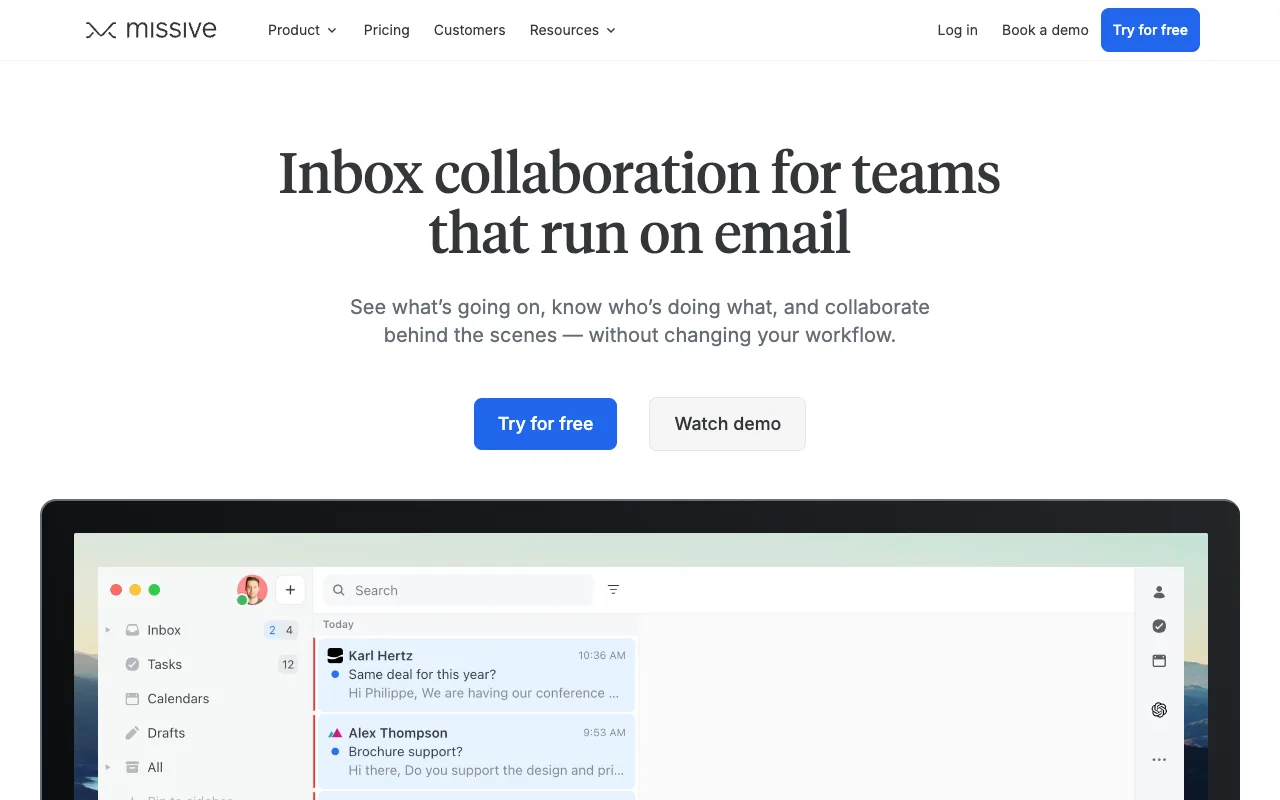
Missive is the inbox. A team moves its whole email there, works from one window and shares the addresses. For a small firm, that is the product.
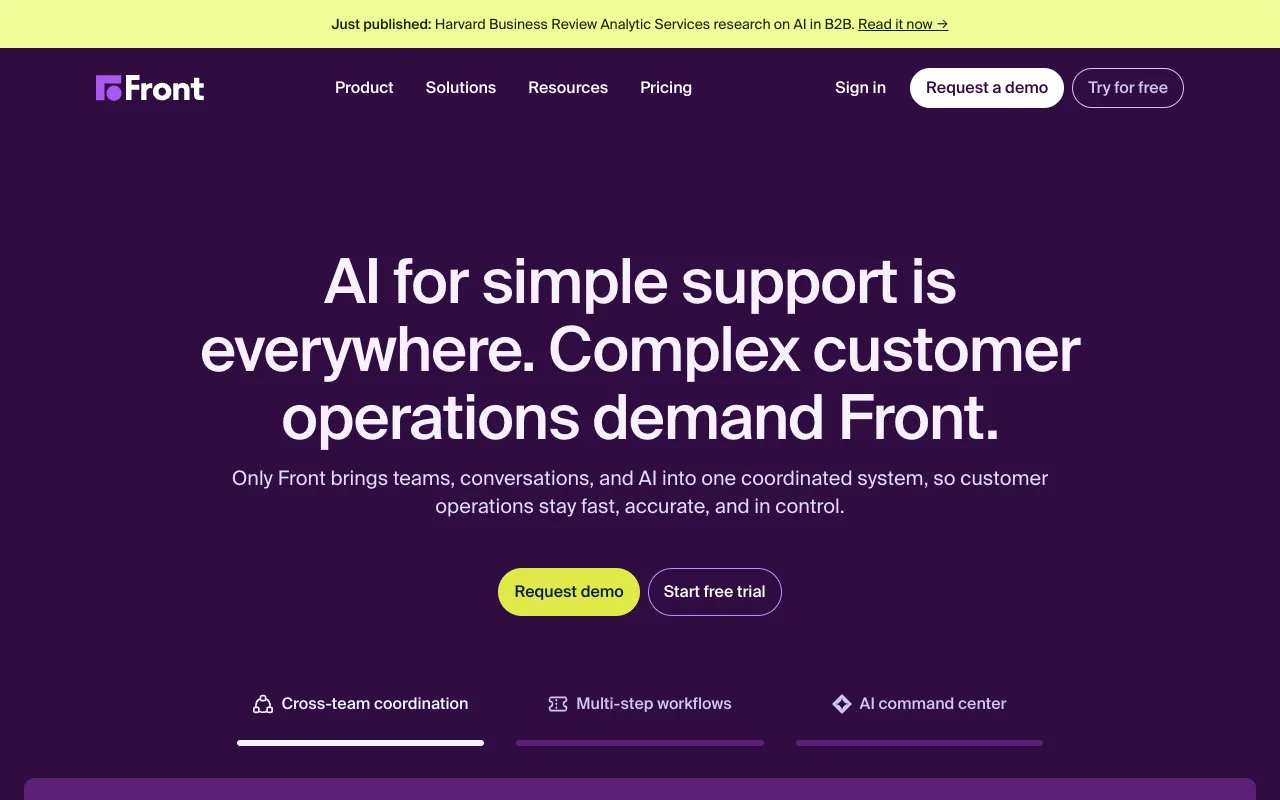
Front assumes a support operation. The Starter tier includes a shared inbox with ticketing, AI Topics, up to 10 automation rules, basic analytics and a no-code knowledge base, on a single channel type. Professional adds omnichannel, macros, advanced analytics and multiple workspaces. Missive’s own entry plan already covers the shared mailbox, so the overlap is most of what a five-person team does.
The difference is what happens past email. One product holds a mailbox a team shares, and the other holds a queue that routes work and reports on it.
What the price difference buys
One line each, because the arithmetic belongs with the arithmetic. Missive publishes three tiers at $14, $24 and $36 per user per month billed yearly, with a 5-user cap on the first. Missive pricing for a small team has what each tier adds and what the bill looks like at three, five and ten people.
Front is $25, $65 and $105 per seat per month billed annually, with the first capped at 10 seats and the top two gated behind a demo request. Front pricing for a small team has the same worked figures.
The entry gap is real, and so is what closes it. Missive’s entry tier has no integrations and no rules, so a team that automates anything is on the second tier. Front’s entry tier includes the queue, the rules and the analytics, and its second tier is $65 behind a sales call.
Where Missive runs out
The first limit is the seat cap. Starter allows five users, and a team that grows past five does not add seats, it moves to Productive. The tighter cap sits on the cheaper of the two products.
The second is scope. Missive holds email, SMS and social in one inbox, and there is no queue that carries a chat and
an address together. If support arrives as a live chat on the marketing site and a message to support@, Missive
holds one of them.
The third is the target. A response-time target that flags a breach, and the reports that go with it, are a different kind of feature from the analytics its tiers list. A team that promised a response time in a contract has outgrown a mail client.
Where Front is more than a small team needs
Front reaches the same wall from the other side. Its Starter plan allows 10 seats and one channel type, so the omnichannel features its own page leads with sit on the tier above. A team that buys Starter for email pays Professional prices the first time a second channel joins the queue.
Professional and Enterprise are a demo request rather than a checkout, so the tier a growing team needs cannot be bought from the page.
The honest cost is configuration. Front gives you routing, saved replies and reports, and a person has to set up and maintain each one. Five people answering mail between other tasks will configure the queue once and stop reading the reports. You pay per seat, every month, for a support function you are not running.
Which to pick, by team
| Your situation | Pick | Why |
|---|---|---|
| Support is one person’s main job, or chat and email share a queue, or a manager reads the reports | Front, on Starter, moving up when the second channel arrives | The routing, macros and channel coverage are the product you are paying for |
| Several people share one address and the mail is the work: sales, a practice, a founder answering everything | Missive | The entry price, a mail client your team will live in, and no queue to maintain |
| Five people ship software and answer their own product’s support in the gaps between other work | Neither, unless you need omnichannel or response-time reporting | You would configure a support function, run it part-time and pay per seat for the unused parts |
There is no winner outside those rows. Front does more, which is worth the money to a support function and overhead to everyone else. Missive does less, which keeps it cheaper and leaves a growing team somewhere to go.
If what you want is neither, Missive alternatives and Front alternatives price the rest of the field, including what is free.
The third option for a team already on Linear
If the third row above is your situation, the missing loop is the customer whose bug is already in Linear.
Chirp costs $9 per user per month on one plan. Press i in a thread to link the issue, snooze until it is done, and
the thread reopens with a draft that names it. The Issues view (g i) ranks linked issues by how many customers are
waiting. Rules close, tag, assign and write drafts, and no rule can send email.
That is the whole reason it exists, and it is narrower than either tool above: email only, with no live chat or phone, and no macros.
Next step
Settle the shape before the vendor. Shared inbox vs help desk covers what each one handles, what a help desk adds and the signals that mean a small team has grown into one.
FAQ
What is the difference between Missive and Front?
Missive is a shared inbox and mail client: a team runs its email there. Front is a customer service platform: a shared inbox with ticketing, routing, channels, automation and reporting on top. Front is the wider product and it costs more.
Is Missive cheaper than Front?
At the entry tier, yes. Missive Starter is $14 per user per month billed yearly against Front Starter at $25 per seat per month billed annually. Missive caps Starter at 5 users and Front caps its Starter at 10 seats.
Can Missive do ticketing?
It assigns conversations and tracks tasks, which is the shared inbox half of a ticketing system. What its published tiers do not list is a response-time target or the reporting that goes with one.
Competitor prices checked October 2026.